Quote the repair from the phone call and send the invoice before you pack up the truck
See All FeaturesFounding member pricing: platform fee waived for 90 days for the first 25 businesses
Handiwork helps handyman professionals turn a quick phone call into an approved estimate, keep a mixed-bag schedule straight, and get an invoice out as soon as the work is finished. Customer history, job photos and online payments sit together on your phone, so nothing depends on a notebook or your memory.
Built by Chris Williams, who framed, painted, and replumbed houses before he wrote software. Meet the founder
Payments secured by Stripe. No card on file to start.
Where the Week Gets Away From You
The repairs are rarely the hard part. The paperwork that follows you home at night is.
Quoting a repair over the phone, then forgetting half the details before you arrive
Juggling one-off repairs, punch lists and multi-day projects in the same week
Invoicing days or weeks late because paperwork piles up after hours
Chasing checks for small jobs that should've been paid on the spot
Job details, like the part a fixture needs or what a customer mentioned on the phone, living only in your head until the next visit
What You Can Run From Your Phone Today
All of this works in your phone's browser, with nothing to install.
Estimates & Quoting
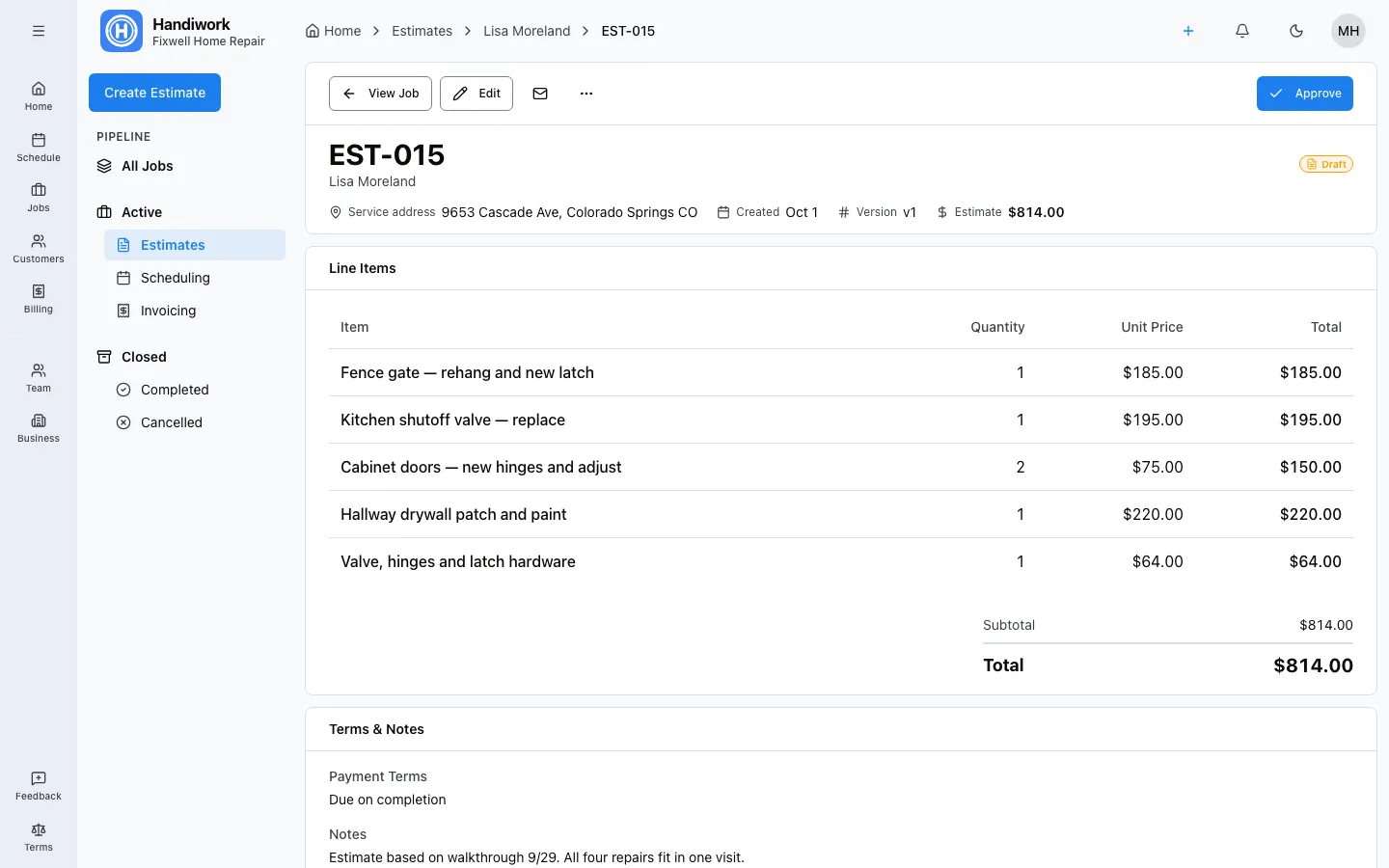
Turn a "can you take a look?" call into a real estimate in minutes. Once the customer gives you the go-ahead, mark it approved and it becomes a scheduled job with one click.
Scheduling & Calendar
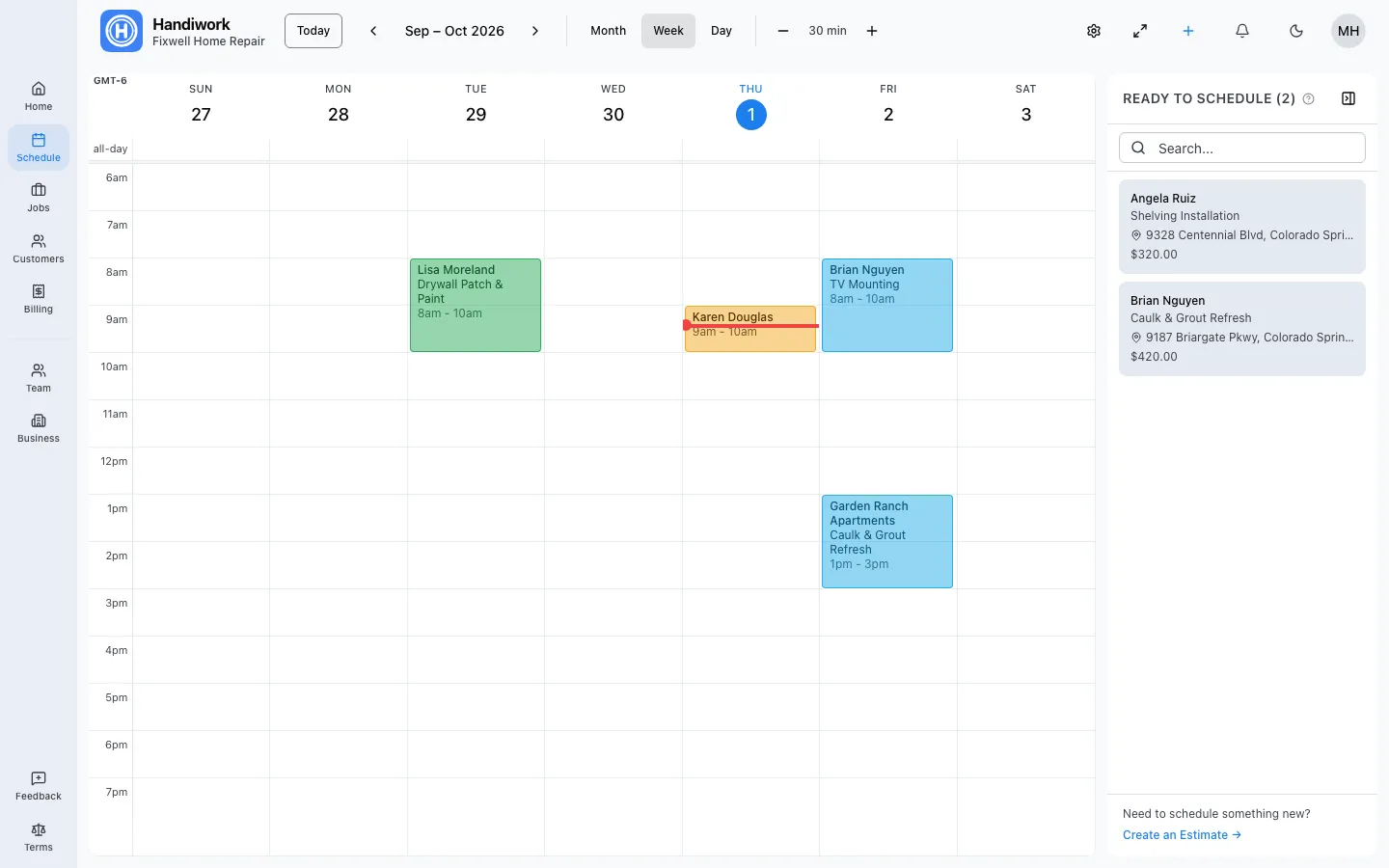
A drag-and-drop calendar for a week that never looks the same twice. Customers get a confirmation email when you book them and reminders before you arrive, so fewer mornings start with a no-show.
Professional Invoicing
Invoice the moment a job's done, with line items for labor and materials, sent straight from your phone.
Online Payments
Take a card or bank transfer through Stripe as soon as the invoice goes out, and refund all or part of a payment if a repair needs a second look.
Customer Management
A full history for every customer you've worked for, with past jobs, notes and photos, so repeat customers don't depend on a good memory.
Business Analytics
The dashboard shows what you've collected this month, which invoices are still unpaid and which finished jobs still need an invoice, so the numbers aren't a Sunday-night project.
Handyman Work Never Looks the Same Twice
One day you’re hanging drywall, the next you’re fixing a leaky faucet, then building a set of shelves before lunch. That variety is what makes the work good, and it’s exactly what makes most business software a poor fit. Off-the-shelf tools assume you do one thing, in one place, on a schedule. Handiwork is made for people who do a dozen different jobs in a dozen different houses in a single week and need to keep the quotes, the schedule and the money straight.
From “Can You Take a Look?” to Money in the Bank
Most jobs start with a phone call or a text, not a formal bid process. Handiwork lets you turn that conversation into a real estimate in a few minutes, with line items for labor and materials, sent straight to the customer’s inbox and easy to open on their phone. Once they give you the go-ahead (a reply, a call, a yes on the doorstep), you mark it approved and it becomes a scheduled job. You don’t re-type anything. When the work’s done, that same estimate turns into an invoice with a pay-now link attached, and Handiwork works out the discount and tax so you’re not doing it by hand on the tailgate. Whatever the job size, the payment runs through Stripe by card or bank transfer, so a $150 faucet fix gets settled as fast as a bigger repair and you’re not chasing a check for weeks afterward.
Every Address, Every Job, in One Calendar
Between punch-list repairs, small installs and the occasional multi-day project, your week rarely looks the same twice. Handiwork’s drag-and-drop calendar holds all of it. Book a two-hour job between two longer ones, and move things around when a customer reschedules. The customer gets an email when you book the visit and another if you move it. Automated reminders go out the day before and again a couple of hours ahead, so fewer customers forget you’re coming and fewer of your mornings start with a no-show.
Punch Lists and Multi-Day Jobs Without Losing the Thread
A lot of handyman work comes as a list. A homeowner’s list starts with “fix the fence gate” and ends up including a leaky shutoff valve and a cabinet door that won’t close, all found on the same walk-through. Handiwork lets you build all of it into a single estimate as separate line items. The customer sees exactly what each piece costs, and you’re not trying to remember which four things you agreed to fix while you’re three jobs down the road. A remodel or a multi-day repair that runs Tuesday through Thursday sits on the calendar the same way a two-hour call does. Book the span, move it if a delivery gets delayed, and when you’re ready to invoice it’s still one job with one running total.
Line Items You Don’t Have to Retype
The same repairs come up again and again: a garbage disposal swap, a patch-and-paint on drywall, a new door sweep. Typing the same line items and prices from scratch every time is where a lot of quoting time goes. As you type a line item, Handiwork suggests the ones you’ve entered before on that phone or computer, with the price and unit filled in, so a common repair drops onto the estimate in a couple of taps. Every line is still editable job by job, for the times a repair turns out bigger or smaller than usual once you’re looking at it.
A House Remembers, and So Does Handiwork
Every customer gets a running history: past estimates, invoices, notes about that weird outlet in the hallway, and photos from the last visit, all on the customer’s record. You don’t re-diagnose the same problem or re-quote work you already did six months ago. If you’re moving off a spreadsheet or a stack of paper invoices, your customer list doesn’t have to start from zero. Import it from a CSV file, and every customer is already there and searchable the next time that phone number calls.
Proof of Work, in Case Anyone Asks
Handyman work gets questioned more than most trades. A property manager wants to see that the repair happened before approving payment. A homeowner’s spouse wasn’t there when you explained what the noise turned out to be. A job needs a record for an insurance claim or a security-deposit dispute. Attach photos straight to the job, like the drywall before you opened it up and the finished patch, and they stay on that job’s record alongside the estimate and the invoice. A before-and-after photo settles the “what did I pay for?” conversation before it starts, whether it’s with a customer, a property manager or a landlord.
A Business of One, or One With Helpers
Everything runs in your phone’s browser: quote a job, check the schedule or send an invoice between stops, with nothing to download. If you bring on a helper or a subcontractor, invite them onto the account. They get their own login and see the same calendar you do, so there’s no phone call to sort out where everyone is headed. Adding them costs nothing, because Handiwork has no per-user fee.
What This Replaces
If you’re reading this on a phone between jobs, there’s a decent chance your current system is a notebook, a spreadsheet, a stack of paper invoices or a thread of text messages you’re trusting yourself to remember correctly. That works right up until a customer disputes a price you quoted out loud, a receipt gets left in a truck that gets cleaned out, or you’re trying to piece together what you billed a repeat customer eight months ago. Handiwork doesn’t try to be a project-management platform for general contractors running big remodels with subcontractor bid packages. It’s made for the common handyman reality: a lot of small and medium jobs at a lot of different addresses, and not much time between them for paperwork.
A few things aren’t here yet. There’s no installed mobile app. You can’t put a named helper on a specific job, so everyone on the account sees the whole calendar. There are no custom job categories for sorting repairs from installs from punch-list work, and no recurring-visit scheduling for standing maintenance arrangements. All of it is on the roadmap, and none of it has a ship date.
Getting set up costs nothing. The fee is 3% of the payments you collect through Handiwork, capped at $79/month, so a slow month costs you little or nothing, and there’s no contract to sign to find that out.
Still Paying Per Lead?
Lead marketplaces charge you before you ever get the job, win or lose. Handiwork works with the customers you already have.
A single shared lead can cost more than a small repair, like a $150 faucet fix, ever earns you, and you pay it whether or not you win the job.
| Model | How you're charged | If the job doesn't close | Monthly cost |
|---|---|---|---|
| Lead marketplaces (Angi, Thumbtack) | Commonly reported $15–$100+ per shared lead (often higher for high-ticket trades), with the same lead sold to several pros at once | You still pay. The fee isn't refunded if you don't win the job. | Scales with how many leads you buy |
| Handiwork | $0 to find work. Handiwork doesn't sell leads. It runs the customers you already have. | Nothing to lose, because there's no lead fee | 3% per payment, capped at $79/mo. $0 until you get paid. |
Lead marketplaces don't publish per-lead rates; figures above reflect commonly reported ranges from contractor forums and industry coverage, not a vendor's own rate card, and vary by trade, market, and bidding activity. Handiwork doesn't sell or resell leads. It handles invoicing, scheduling and payments for the jobs you already have.
You already have customers. A lead marketplace charges you to meet a stranger who might hire someone else. Handiwork charges nothing to run the business you've already built.
Quote your next repair from Handiwork
No subscription. You pay 3% of what you collect through Handiwork, capped at $79/month.
Get Started FreeHandiwork for Other Trades
The estimates, calendar and invoices you use for repairs work for these trades as well.